Music can decide whether guests remember your wedding reception as a beautiful evening or the night when nobody wanted to leave the dance floor.
That makes choosing between a live band vs DJ for wedding entertainment more important than it initially seems.
A live band can give the celebration personality, interaction and the excitement of watching musicians perform in real time. A DJ can provide a huge music library, smooth transitions and hours of uninterrupted dancing. And for couples who want elements of both, DJ-based bands now combine electronic mixes with live vocals and instruments.
So, which is better? There is no single answer for every wedding.
A wedding live band is often better when you want the music itself to become part of the experience. A wedding DJ is usually stronger when continuous dancing, genre flexibility and a large song library are the priority. For some celebrations, using both—or booking a hybrid DJ-based band—creates the strongest result.
This guide compares the options across atmosphere, music selection, cost, guest engagement, venue requirements and different Indian wedding functions so you can decide what actually fits your celebration.
Live Band or DJ for a Wedding?
Choose a live band if you want:
Choose a DJ if you want:
Choose a DJ-based band or a combination of live band + DJ when you want the energy and visual impact of live musicians without losing the dance-floor flexibility of a DJ.
Alive Experiences currently offers conventional live bands as well as DJ-based groups that combine live instruments, vocals and DJ mixes for weddings and other celebrations.
| Factor | Live Band | Wedding DJ |
|---|---|---|
| Live performance | Excellent | Limited |
| Song library | Depends on repertoire | Very large |
| Crowd interaction | High | High |
| Visual impact | Strong | Depends on production |
| Genre flexibility | Moderate to high | Very high |
| Continuous music | Requires set planning | Excellent |
| Space required | Usually more | Usually less |
| Technical complexity | Higher | Lower |
| Personalised performance | Strong | Strong in playlist selection |
| Concert atmosphere | Excellent | Limited |
| Late-night dancing | Good | Excellent |
| Ideal for | Cocktail, reception, premium entertainment | Sangeet, reception, after-party |
The important thing is not to ask which option is universally better.
Ask instead:
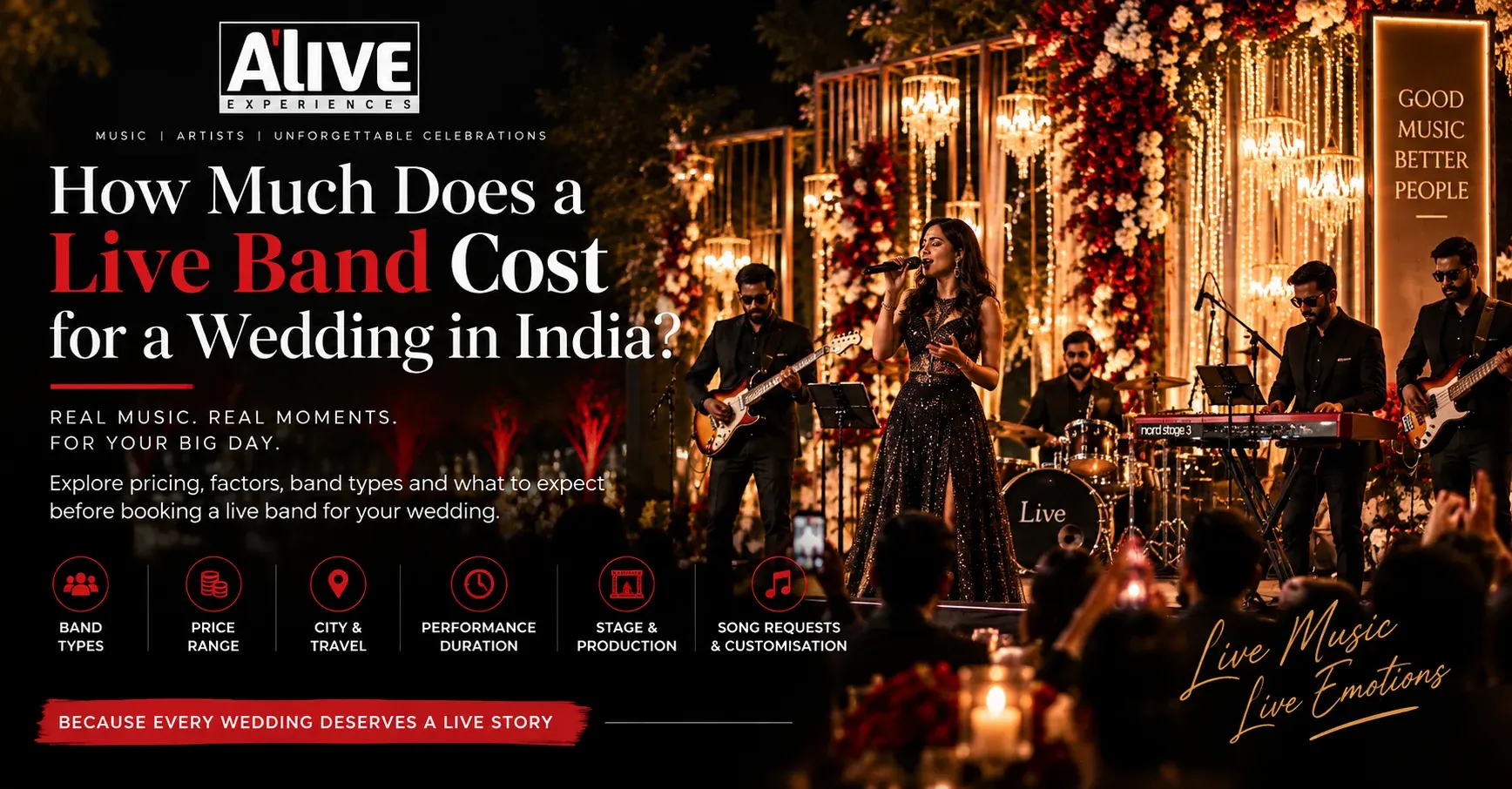
A live band turns music from background entertainment into a visible performance.
Guests see the singers, musicians and instruments. The performers can communicate with the audience, react to the dance floor and alter the energy according to what is happening in the room.
That unpredictability is part of the appeal.
Imagine a singer beginning a familiar Bollywood chorus and gradually letting your guests take over the vocals. Or a percussionist extending a section because the dance floor is suddenly full.
Those moments cannot be reproduced exactly by pressing play on a recorded track.
Alive Experiences currently lists live acts covering Bollywood, fusion, pop, rock, R&B and other styles, including bands such as Twin Strings, The Story Teller, The CopyCats, The Bartender, Aakhira and The Bollywood Tales.
A live band is therefore not simply providing songs.
It is providing a performance.
A professional wedding DJ approaches music differently.
Instead of being limited to songs musicians have rehearsed, a DJ can potentially work with thousands of tracks.
That means the music can move from old Bollywood to Punjabi, commercial English, house, retro Hindi or current chart music within minutes.
This flexibility becomes particularly useful when the wedding has a mixed crowd.
If one genre is not working, the DJ can change direction quickly.
DJs are also naturally suited to longer party windows. A live band generally works in planned performance sets, while a DJ can maintain continuous music throughout the evening and into the after-party.
For couples who primarily want guests dancing rather than watching a performance, that distinction matters.
For pure live-performance atmosphere, the band has a natural advantage.
Real instruments and vocals bring movement to the stage even before guests start dancing.
A band can also make the event feel more exclusive because the music is being created in front of the audience rather than played from recordings.
This works particularly well for:
A DJ creates a different kind of atmosphere.
Instead of becoming the main focus of the room, the DJ often supports the party happening around them.
When lighting, LED screens and production are added, a DJ-led wedding can still feel extremely high-energy and visually impressive.
The better choice depends on whether you want guests to watch and participate in entertainment or primarily dance to it.
The DJ wins this category quite clearly.
A live band's repertoire may contain dozens or hundreds of songs, but musicians still need to know and rehearse what they perform.
A DJ has access to a far wider selection of recorded music and can move between artists, languages, decades and genres almost instantly.
That becomes valuable at Indian weddings because the audience may want everything from:
However, quantity is not everything.
Hearing a familiar song performed differently by a talented live band can sometimes create far more impact than simply playing the original recording.
So the question becomes:
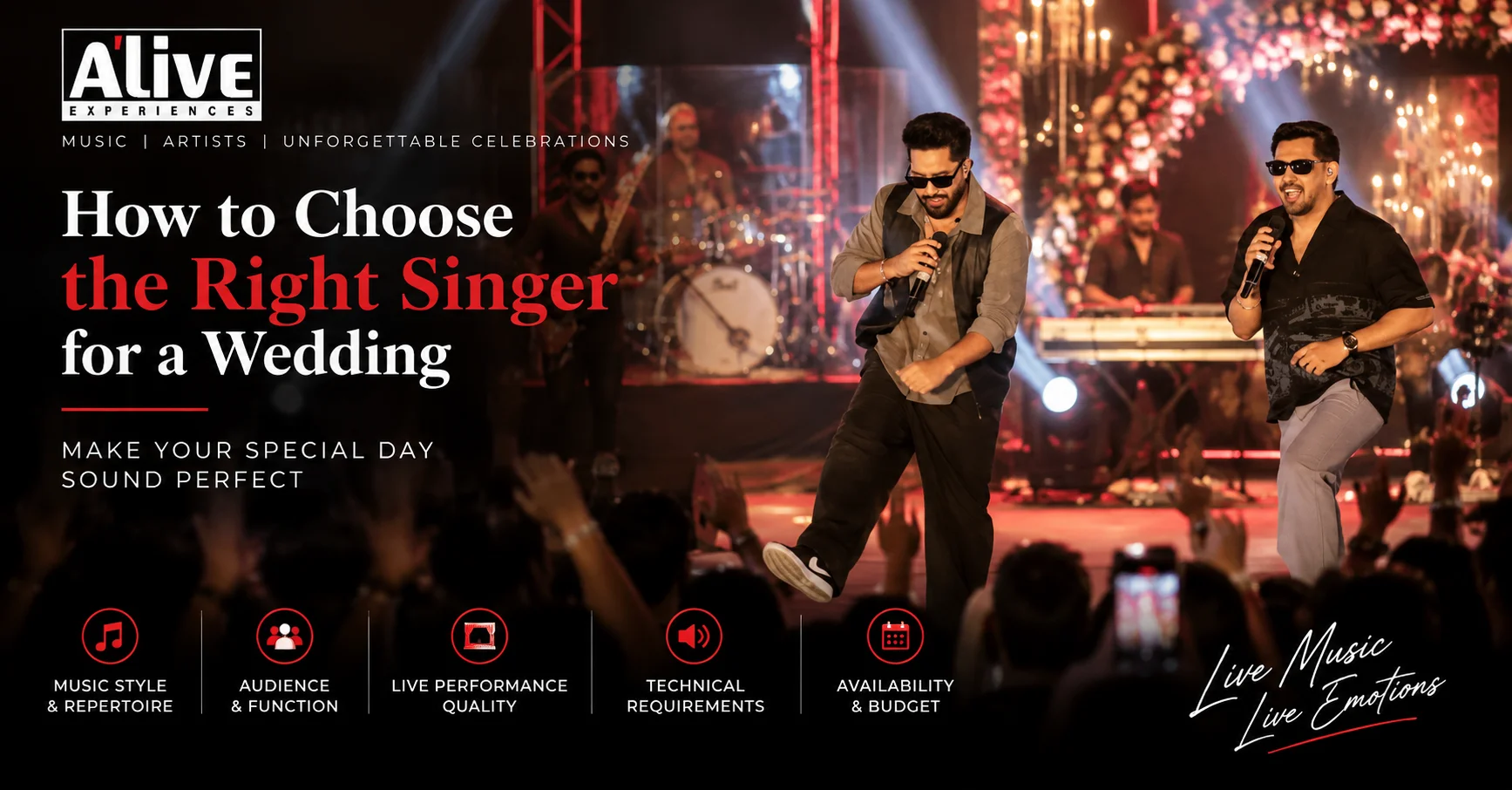
Both can interact with guests, but differently.
A singer can talk directly to the couple, invite the audience to sing, dedicate songs and adjust the performance based on audience response.
Musicians can also extend popular sections when guests are particularly engaged.
That gives the performance a spontaneous feeling.
A skilled wedding DJ reads the crowd through the dance floor.
If guests react strongly to Punjabi music, the DJ can stay in that direction. If the energy falls, they can quickly change genre or tempo.
Some DJs also use microphones to engage guests and build anticipation.
A DJ therefore interacts through music selection, whereas bands usually combine music selection with visible live performance.
If continuous dancing is your biggest priority, a DJ usually has the advantage. There are several reasons.
First, there are no natural performance breaks.Second, the DJ can transition continuously from one high-energy song into another. Third, requests can often be accommodated quickly.
A live band can certainly fill a dance floor- especially Bollywood, Punjabi and commercial bands—but the experience usually feels more like attending a performance that becomes a party. That difference is subtle but important.
For a reception where you want an entertainment highlight followed by dancing, a live band works beautifully.For an after-party expected to continue for several hours, the DJ becomes particularly valuable.
For many Indian receptions, a live band can be one of the strongest entertainment choices because guests typically have time to sit, socialise and watch a performance.
Alive Experiences currently offers wedding reception singers and bands across different styles and booking budgets, from acoustic performers to energetic Bollywood-focused acts.
A typical flow could be:
Guest arrival: Soft background music
Couple entry: Selected entry track
Main reception: Live-band performance
Later evening: DJ and open dance floor
This arrangement avoids forcing one entertainment format to perform every role.
A sangeet already contains choreographed performances, entrances and planned moments. Because of that, a DJ is often essential for playing exact choreography tracks. However, that does not mean the entire night needs to remain DJ-led. A live band can begin once family performances are complete. That creates a natural transition:
Choreographed sangeet performances → live band → DJ after-party
This gives the evening different entertainment phases instead of one continuous format. For high-energy sangeets, Bollywood-Punjabi live bands or DJ-based bands can also work particularly well.
A cocktail night may be the ideal function for a wedding live band. Guests are usually socialising rather than following a highly structured ceremony. The band can begin with relaxed contemporary or acoustic music and gradually increase the energy.
Depending on your audience, that may include:
Because cocktail events are naturally entertainment-focused, the live performance becomes part of the identity of the evening rather than simply background music.
A DJ can then continue the party once the band's performance ends.
Mehendi celebrations usually need lighter entertainment than a large reception.
Guests are moving around, talking, eating and participating in the ceremony. That makes an acoustic band, Sufi act, folk-fusion setup or compact live group a strong choice. If your mehendi is designed more like a daytime party, a DJ can work equally well. The decision depends less on tradition and more on the style of function you are creating.
Destination weddings often benefit from both formats. A live band can make the welcome evening or cocktail event feel special, while a DJ handles the high-energy sangeet or after-party. However, live bands can involve more logistics because multiple musicians, instruments and technical equipment may need to travel.
Before booking, confirm:
A DJ generally requires fewer travelling performers, although sophisticated DJ production can still involve substantial lighting, LED and sound requirements.
There is no universal pricing rule because both categories include performers across very different budget levels.
However, a full live band often involves more people and logistics than one DJ.
A band may require:
A DJ may require fewer performers but can still involve significant production costs when elaborate sound, lighting or LED setups are included.
Alive Experiences currently lists wedding reception singers and bands across budget brackets ranging from below ₹2 lakh through higher-value categories reaching ₹20 lakh, depending on the performer and requirements.
Its DJ-based wedding band offering also spans multiple budget brackets and can include performance, travel, accommodation and stage requirements depending on the chosen package.
Therefore, compare total entertainment cost, not simply the artist's headline fee.
A DJ-based band sits between the traditional band and DJ formats.
Instead of choosing recorded mixes or live musicians separately, this format combines them.
A performance may include:
Alive Experiences currently lists DJ-based acts including Bollyjammers, Tamasha, Aqua Beats, Tanush, Filmee, Nautanki, Urban Turban and others. Aqua Beats, for example, is presented as a format combining DJ music with live instruments and vocals.
This format can work well when couples want dance-floor energy but still want something visually stronger than a conventional DJ setup.
| Requirement | Live Band | DJ | DJ-Based Band |
|---|---|---|---|
| Live musicianship | Excellent | Low | High |
| Song flexibility | Medium | Excellent | High |
| Stage presence | Excellent | Medium | Excellent |
| Continuous dancing | Good | Excellent | Excellent |
| Performance feel | Excellent | Medium | Excellent |
| Setup complexity | Higher | Lower | Higher |
| Genre switching | Good | Excellent | Very good |
| Best for after-party | Good | Excellent | Excellent |
| Best for concert feel | Excellent | Low | High |
The hybrid format is especially relevant for couples who find the DJ vs live band decision too restrictive.
A live band makes sense when the entertainment itself needs to become a memorable element of the wedding.
Consider one when:
Alive Experiences represents live bands covering Bollywood, fusion and contemporary genres, making it possible to shortlist acts based on the musical identity of the wedding rather than choosing one generic band format.
Choose a DJ when:
The ability to change direction instantly is one of the DJ's biggest advantages.
For many weddings, this is the most practical solution.
You do not need to force one entertainment format into every part of the evening.
For example:
7:30 PM: Guest arrival music
8:30 PM: Couple entry
9:00 PM: Live band begins
10:30 PM: Band concludes
10:45 PM onward: DJ and dancing
Family performances: DJ
Main entertainment: Live Bollywood band
After-party: DJ
This approach gives guests a genuine performance and uninterrupted dancing later.
Before booking, answer seven questions.
An intimate dinner requires different entertainment from a 600-person reception.
Some families love performances. Others want to dance immediately.
Know your crowd.
If your favourite music sounds especially good live, choose a band.
If your playlist jumps constantly between genres and eras, consider a DJ.
Bands usually require more space than DJs.
Ask your planner for the actual performance area before confirming the act.
A scheduled 60–90 minute live performance and a five-hour dance party require different solutions.
Include artist fee, travel, accommodation, production, stage and technical requirements.
Do not choose entertainment without considering the function.
The same couple might correctly choose a live band for the cocktail and DJ for the sangeet.
Before confirming either format, ask:
If you are booking a live band, also ask exactly how many musicians will perform.
If you are booking a DJ, discuss playlist preferences and songs you specifically do not want played.
Alive Experiences currently represents more than 1,000 artists and states that it has worked across more than 10,000 shows, with wedding entertainment categories covering live bands, DJs, DJ-based bands, singers, Sufi performers and other formats.
Instead of choosing a format before understanding the options, couples can begin by sharing:
Suitable performers can then be shortlisted based on availability and event requirements.
That approach is far more useful than simply searching for the “best wedding DJ” or “best wedding band” without considering whether the performer suits your actual celebration.
A live band is better for couples who want a performance-focused experience, while a DJ is generally better for continuous dancing and broad music selection. Many weddings successfully use both.
Often, but not always. Bands may involve several musicians and greater production requirements. Premium DJs and elaborate DJ production can also be expensive, so compare complete quotations.
A live band can work particularly well for the main reception entertainment, followed by a DJ when the open dance floor begins.
A DJ is extremely useful for choreographed performances because exact tracks are required. A live band can take over after the performances.
Yes. In many cases this creates the strongest entertainment flow because the band provides the performance while the DJ handles continuous dancing.
A DJ-based band combines recorded DJ mixes with live vocals, instruments or percussion. It offers elements of both traditional formats. Alive Experiences currently offers several such acts for weddings.
Many bands accept selected requests if discussed beforehand, but their repertoire is naturally more limited than a DJ's song library.
A professional DJ usually has access to a broad music library, although couples should still discuss important tracks before the event.
A full live band normally requires more stage space because of musicians, instruments, microphones and monitoring equipment.
Both work well. A band can create memorable welcome or reception entertainment, while a DJ is ideal for sangeets and after-parties. Band travel logistics may be more complex.
Yes. An acoustic duo, trio or compact band can suit intimate celebrations without requiring a large production setup.
A DJ is generally the stronger choice because music can continue without performance breaks and change rapidly according to the crowd.
Many Indian wedding bands perform Bollywood, Punjabi and contemporary music, but individual repertoires vary. Review the band's song selection before booking.
Popular performers can become unavailable on peak wedding dates, so beginning the booking process early gives you more choice and additional time for production coordination.
Consider your function, audience, music preferences, desired atmosphere, venue size, duration and budget. Then compare suitable live bands, DJs or hybrid acts rather than selecting purely on popularity.
The live band vs DJ for wedding debate does not need one universal winner.
They create different experiences.
A live band brings musicianship, personality, interaction and visual performance to the celebration. A DJ offers flexibility, enormous musical variety and the ability to keep the dance floor moving continuously.
And increasingly, couples do not have to choose only one.
A live band can headline the cocktail or reception. A DJ can handle the sangeet choreography and after-party. A DJ-based band can combine electronic music with live vocals and instruments.
The right choice comes down to one question:
If you want them to watch, sing along and feel part of a live performance, explore a wedding live band.
If you want several hours of dancing across multiple genres, consider a wedding DJ.
If you want both experiences, combine them.
Planning your wedding entertainment? Share your wedding date, city, function, preferred music style and approximate budget with Alive Experiences. Their team can help you explore live bands, DJs and DJ-based acts, compare suitable options and coordinate the entertainment around your wedding format.